
Days before Hadassah Foundation staff and board were scheduled to depart for an Israel mission, we hosted a small kick-off Zoom briefing with journalist and filmmaker Anat Saragusti, journalist and media analyst Kholod Massalha, and law professor Yofi Tirosh. To prepare for meetings and site visits with more than 15 Israel-based grant recipients, we sought diverse perspectives on challenges and opportunities for advancing gender equity in Israel. While the mission was canceled as a result of the Iran war, the issues raised by these three leading feminist thinkers are important for anyone who cares about Israel’s future as an equitable and democratic state.
Each speaker was asked to share what she believes are the most important issues for Israeli women in 2026, an election year. From the scarcity of women in government leadership to the dangers faced by Arab women to the expanding power of all-male religious courts, the challenges our speakers described are formidable and have become even more so since the war began. What gives us hope, however, is that our Israeli grant recipients are at the forefront of addressing these challenges and building a better and more equitable Israel. Below are condensed and edited highlights from the briefing and Q&A that followed. Scroll to the bottom for bios of each speaker.
Anat Saragusti: In Wartime, Women’s Voices are Absent
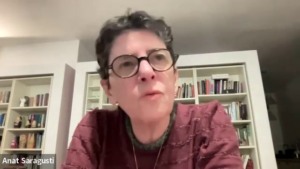 Every time a war erupts, all the breaking news is filled with ex-generals, most of them men, who are invited to explain the reality to the frightened audiences at home. It’s not only that women are absent on the news; it’s also the perspectives that women can bring to the conversation, which is absent. Since October 7 we have been overwhelmed with the perspective of the army. What we lack is the perspective of the civilians, particularly women. In the government ministries, women are not represented at all, so what we see is a very male-dominated picture of reality. And this is really disturbing, because it has taken us backwards.
In Israel, when there is an emergency, everybody’s glued to the television, so it really influences our mindset when we see only ex-generals in the studio.
Kholod Massalha: Arab Women Are Prosecuted Instead of Protected
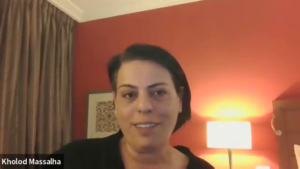 To understand Arab women’s reality in Israel today, you need to place three layers on top of each other. The first is violence. Arab communities in Israel have been facing an ongoing wave of gun violence and organized crime. People are killed in the streets, near their homes, outside schools, and at weddings. Families live with constant fear. Businesses pay protection money. Illegal weapons are widespread. For women, this violence enters the home, affects mobility, employment, and their children. It creates a daily sense that life is unstable.
The second layer is the state response, especially policing. The dominant experience in many Arab towns is not that the state is absent entirely. It is that the state is inconsistent. It arrives quickly in some contexts, slowly in others. It uses force strongly in some cases, weakly in others. When murders remain unsolved, and firearms continue circulating, people interpret this as a message that their lives are not an urgent national matter. And for women, this becomes personal. Because women rely on institutions in specific ways. They need the police when there is domestic violence. They need protection orders enforced. They need intervention when there are threats. They need the state to dismantle organized crime networks that control neighborhoods.
The third layer is the political climate. Since October 7, we have seen a hardened environment where Palestinian political expression is treated with suspicion. Social media posts become cause for investigation, and criticism of government actions becomes a security file. Women have been detained, questioned, or threatened because of social media posts. Students have been interrogated. Professionals have felt pressure at work.
So Arab women face a dual reality. When they ask for protection from violence, the response is weak, slow, or dismissive. When they express political views, the response can be fast, strict, and punitive. It tells Arab women: Your safety is negotiable, your speech is dangerous. Now let me connect this to representation. Arab women are almost completely absent from the national power centers where security and policing priorities are set. There is no access to the rooms where the decisions are made. There is no role in shaping budgets, priorities, or accountability. When Arab women are absent from that structure, their experiences do not become policy. They become “stories.” And stories, in systems of power, can be listened to or ignored. When Arab women appear in media narratives, they are often placed in two narrow roles: as victims of Arab society or as suspect political actors. Rarely as equal citizens with a right to protection and a right to free speech.
Yofi Tirosh: Religious Laws Silence and Segregate Women
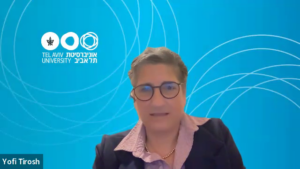 We are constantly needing to respond, trying to block legislative initiatives that, at the beginning, you think, “Oh, this is just a crazy headline to appease the base” but then they keep advancing and become actual threatening realities.
Just this morning, the Knesset made another step in advancing a law that would instill strict regulations on prayer at the Western Wall. Only prayer services that the Orthodox state-sponsored body of rabbis approves of will be legal. Other forms of prayer will be criminalized with heavy penalties, and it is very clear that the focus of this law is to harm the autonomy and equality of women. Because one thing that the Chief Rabbinate really hates is when women read the Torah, a female cantor leads the prayer, or there is a prayer service where men and women sit together.
Another law that is in its final stages is a law that authorizes religious courts to serve as arbitrators in civil matters, not just marriage and divorce. [The law was passed on March 23.] This new law means that if my landlord puts a line in the lease that says if we have a dispute, the rabbinical court will arbitrate, then I will find myself, a Tel Avivian woman, standing in front of a panel of three judges, all Orthodox or ultra-Orthodox rabbis, all male, most of them without general legal education, only with halachic education. And we have a lot of precedent indicating that they will not identify with the women in the court. Even more importantly, this law will expand the grip of religious law over more and more areas of our lives. And this is a very, parochial and deeply conservative interpretation of Judaism.
Now I will mention my “pet topic”, which is gender segregation, a rampant phenomenon in Israel. We have gender-segregated academic programs for the ultra-Orthodox that were designed to give them access to higher education. And now the Knesset is advancing a law that would extend the gender-segregated academic programs to the master’s and PhD levels, which is just unviable. I don’t know, as an academic, how this would look. A gender-segregated lab? I cannot take a male dissertation advisee? But this, again, is advancing very, very quickly.
QUESTION: Where do this year’s elections fit in? Is it likely that a new government will come to power that will improve the gender-equity situation?
Anat: I don’t expect the current government to make any changes in terms of its approach to gender equity or anything like that. It is driving so fast in the other direction. To achieve change, we will need to elect a new government, and I think we would need all those running for office to make a very direct and open statement that gender equality is very high on their agenda.
Yofi: I agree with Anat that the election results will be pivotal, yet I am pessimistic about the prospect of quickly undoing a lot of the backlash that we have been experiencing in the past three years. Even if tomorrow we’ll have a coalition of liberal parties, many secular Israelis are still captive to what I call the liberal tolerance paradox. They are buying into the argument that says, “You have to be tolerant of religious norms. You have to let us send women to the back of the bus, or ask women to move on the airplane, because this is our culture, our way of living.” And what liberal Israelis don’t recognize is that the religious right isn’t interested in tolerance and multiculturalism. It wants to enforce one way of Judaism and one way of being an Israeli on all Israelis.
Kholod: I am more hopeful that the situation for Arab society will change as a result of the elections than the situation for women overall. If the government moves to the center or left, it could help the Arab society as a whole, which would improve the lives of Arab women. Bukra, where I am an editor, is doing a lot to get out the Arab vote this year, especially to get out the votes of Arab women.
Speaker Bios
Kholod Massalha is a journalist, editor, and media leader from Arab society in Israel. She serves as the CEO of I’lam – the Arab Center for Media Freedom, Development and Research, where she leads research, advocacy, and field monitoring focused on protecting freedom of expression and strengthening independent Arab media. A central part of I’lam’s work is professionalizing journalists through hands-on training, ethical and editorial tools, and long-term capacity building, with a strong emphasis on supporting women journalists and expanding their opportunities, safety, and visibility in newsrooms and public debate. Alongside her role at I’lam, Massalha is an editor at Bokra, an independent Arabic digital news site that covers political, social, and economic issues affecting Arab citizens in Israel, and provides daily reporting and analysis that amplifies underrepresented voices and debates.
Anat Saragusti is in charge of the Freedom of the Press at the Union of Journalists in Israel. Saragusti is a documentary filmmaker, book editor, and a freelance journalist and commentator. She writes op-eds in major newspapers and websites in Israel and has been invited to panels, mainly on issues of press freedom, state security, women participation in decision-making processes, the Israeli-Palestinian conflict, and other current affairs. Saragusti is a laureate of the 2016 “Unsung Hero” Drum Major for Justice Award for “exceptional global leadership, commitment to the elevation of humankind through advocacy and awareness, and for personifying the spirit of Dr. King’s core philosophies.” She has a master’s degree in law.
Yofi Tirosh is an Israeli legal scholar and a prominent civil rights activist. She is an associate professor, the former Vice Dean of Curriculum and Students at the Tel Aviv University Faculty of Law, and the former Dean of the Sapir Academic College School of Law in Israel’s south (Negev) region, the region where she was born and raised in Moshav Maslul, an agricultural community. Tirosh is also a Kogud Senior Research Fellow at the Shalom Hartman Institute in Jerusalem and a rabbinical student at Jerusalem’s Hebrew Union College. Her research on antidiscrimination law, feminist jurisprudence, and law and culture has been published in leading international and Israeli journals.Tirosh completed her doctorate at the University of Michigan Law School, where she was a fellow at Michigan’s Institute for the Humanities. After earning an LL.B from the Hebrew University of Jerusalem, she clerked for the late Justice Mishael Cheshin in Israel’s Supreme Court. She served as a research fellow at New York University School of Law, Humboldt University in Berlin, and as a Visiting Professor at Georgetown Law Center, Queen’s University Faculty of Law in Ontario. Alongside her research, teaching, and academic leadership, Tirosh is a prominent civil rights activist, serving on numerous civil rights NGO boards and working with policymakers and civil society organizations, and consulting pro bono on impact lawyering to promote gender equality. She received several distinctions for integrating academic work and public service, including the Gorny Award by Israel’s Public Law Association and the Vivian Silver Award for promoting peace and gender equality. Tirosh was listed as one of Israel’s 100 most influential people by The Marker, Haaretz’s financial magazine (2020). Since November 2022, she has been taking a central role in the efforts to curtail Netanyahu’s government judicial overhaul and its attacks on Israel’s democracy. Tirosh is a regular contributor of legal analysis in leading media venues in Israel, including Haaretz, Yediot Aharonot, and the main television and radio news channels. Her activism was covered by the New York Times, the Washington Post, the Wall Street Journal, Slate, and more.