

Last month in Brooklyn, three Hadassah Foundation grant recipients were front and center in a conversation about cultivating Jewish women’s leadership from safety and strength. Leaders of Shalom Task Force, Sacred Spaces, and I Was Supposed to Have a Baby participated in a panel discussion moderated by Hadassah Foundation Board Member Negar Treister. Below are edited and condensed highlights. Scroll to the end to learn more about these organizations and their CEOs. (In the image above, Hadassah Foundation Board Member Negar Treister speaks to Keshet Starr of Shalom Task Force.)
What Their Organizations Do

Aimee Baron (Shulamit Photo & Video)
Aimee Baron, I Was Supposed to Have a Baby
We seek to transform how the Jewish community supports people facing fertility challenges and pregnancy loss. We provide mental health support, educational resources, and a warm, nurturing space through digital platforms, communal gatherings, and connections to broader support networks. Our work covers all fertility journeys, including infertility, miscarriage, stillbirth, infant loss, termination for medical reasons, donor conception, adoption, and surrogacy. At the heart of what we do is helping individuals feel seen and less alone during some of the most vulnerable moments of their lives.
We also know that we need to educate the friends, family, and professionals who surround those who are struggling. We offer sensitivity training for rabbis, other clergy, doctors, educators, and workplaces to hold people who are suffering. With one in six couples experiencing fertility challenges and one in four pregnancies ending in loss (these are the statistics worldwide), people often lack the language and understanding to understand the pain that these individuals and families feel. We work to fill that gap, creating spaces where people can navigate these experiences with empathy.
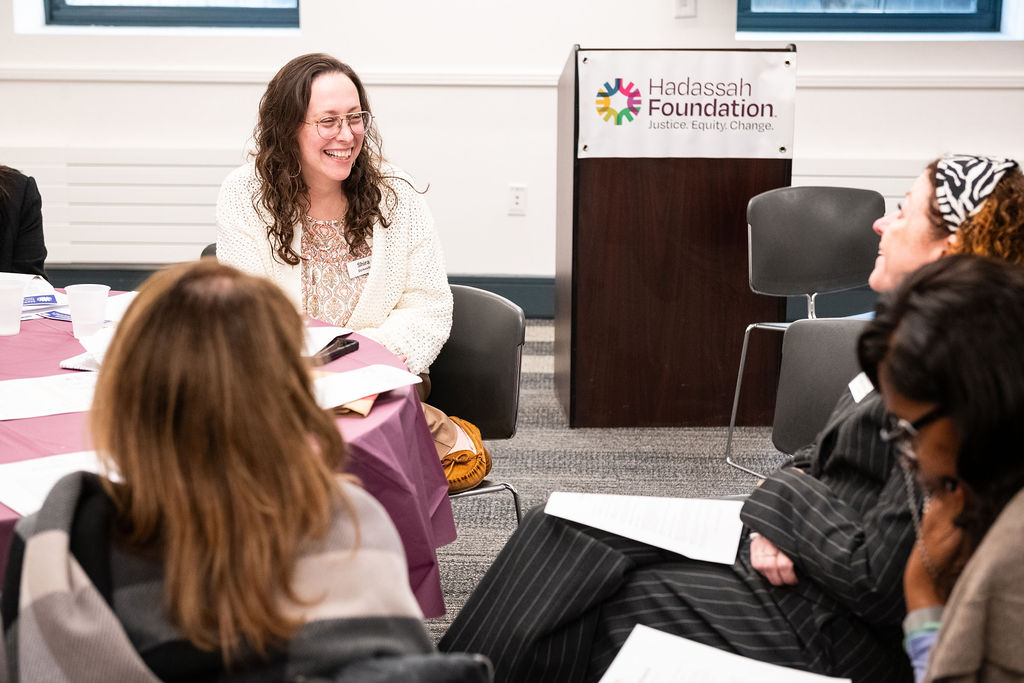
Shira Berkovits leading a breakout session after the panel. (Shulamit Photo & Video)
Shira Berkovits, Sacred Spaces
We work to prevent and respond to abuse. Most leaders want to do the right thing. When they mess up, it’s generally not nefarious, but because they don’t know better. Or because multiple people are involved in responding to a report, and everybody gets it like 90 percent of the way correct, but that 10 percent adds up to pretty egregious mishandling.
In terms of prevention, we want to ensure Jewish organizations have structures and systems in place that prevent abuse. In the same way that you wouldn’t open a Jewish institution without making sure you’re up to fire safety code, or have done your fire drills, we need to be prepared to safeguard from abuse, and handle it promptly and ethically when somebody comes forward.

Keshet Starr (Shulamit Photo & Video)
Keshet Starr, Shalom Task Force
If we are not safe in our families and our most intimate relationships – if that part of our life is dangerous either physically or psychologically – there’s no foundation to accomplish all of the things that we have the potential to accomplish in the world.
In addition to providing a range of services for people experiencing abuse, we really believe that education is the key. You can prevent a lot of suffering when you raise a generation of young adults who are able to identify abuse and attuned to the needs of people experiencing it. If you can’t define why a relationship feels off, you’re not even at stage one of being able to get help. We also want to make sure that if someone shares with a person that they’re experiencing abuse, that person will know what to do.
Leadership
Aimee: When I started this organization, I kept thinking, “I’m a pediatrician, not a nonprofit leader.” But I realized that the values that brought me into medicine, compassion, care, and really seeing people, had to come through in the way I run this organization. I want the same support and comfort that we provide to our community to also exist inside our walls. That means making sure every person on our team has a voice, that collaboration and empathy aren’t just words we use–they are models by which I lead, so that people feel heard and respected. Because for me, leadership isn’t about titles or hierarchy; it’s about creating a space where people feel empowered to do their best work.

Aimee Baron leads a breakout session after the panel. (Shulamit Photo & Video)
Shira: The MeToo movement brought a lot of attention to issues of sexual harassment, assault, and violence in the workplace and elsewhere. That was good, but suddenly it felt like almost everything, even more minor incidents, were being called toxic.
Heads of Jewish organizations were calling and saying things like, “I don’t think I want to be in this role anymore. Tomorrow it could be me on the front page of that newspaper, not because I’m abusing someone, but because I said the wrong thing,” or, “I’m just waiting to be fired.” Leaders in the Jewish community were afraid to lead, for fear of taking a wrong step and getting cancelled.
Some of our work has been in sitting through difficult situations with Jewish leaders and helping them to realize that dealing with reports of abuse or harassment doesn’t have to be career-ending, but can be career-defining. I think in particular of one head of school who made some really bold choices, such as including the family members and the therapists of all the involved parties – the people who had been harmed and the people who had caused the harm. They brought the community together to talk about accountability and support. Instead of dividing the community, they came together in dealing with a really complex situation to enhance safety and dignity for all.
What would it look like if our Jewish communities showed a different kind of ethical leadership when there is a crisis – not to pick up the phone and call an attorney or communications firm – but to think about how we can bravely walk through this together as a community, to rectify wrongdoing and work to prevent repeat harm in the future?
Keshet: A lot of our prevention work, especially with youth, is also leadership development training. Our goal is that after students graduate from our fellowship programs, they will not only understand domestic abuse better, but they’ll have the tools to use their voices for whatever they care about. When we’re working with people who are experiencing domestic abuse, our primary goal is to give them agency as we talk through what they’re going to do next and what the choices are. This work can be hard, but one of the real rewards and gifts is that we also get to see women really come into their power and come out of these situations and make choices and go back to school and accomplish the things that they always wanted to do. Some of our work is stepping out of the way so that they can live the lives that they really were meant to live once this suffering is gone.
What Gives Them Hope
Aimee: Almost every week—probably four or five times—I get a message from someone who is pregnant asking, “How do I tell my good news without hurting my friend who’s struggling to get pregnant or just lost a baby?” And honestly, those messages give me so much hope. It means our message is getting across! People are noticing that those around them are hurting, and they genuinely want to do better. It means people are stopping to think about how their joy might impact someone else, and they care enough to make it a little easier. If we can give them the words to share their news in a way that’s thoughtful and less emotional, it can take just a bit of the sting away. That tiny bit of care, that thoughtfulness, that’s what gives me hope.
Shira: In 2019, I was invited to the White House for a meeting on sex trafficking. I arrived and took my place at the back with other professionals and advocates, prepared to listen to the discussion that would commence at the table in the center of the room. I noticed that before we could begin, we were waiting for one person, and I joined others in looking around to see who that could be. It took a moment for me to read the nameplate at the empty seat and realize we were waiting for me! I literally had a seat at the table. I say this because how many women in this room have sat here at some point and thought, “It’s not my place. I can’t speak up.” And then we turn around and realize, “Wait a second, I’ve got the seat at the table.” So what’s giving me hope is all of us — we’re going to take our seats, and we’re going to make a difference.

Keshet Starr and her colleague Jeffrey Younger lead a breakout session after the panel. (Shulamit Photo & Video)
Keshet: One component of what we do is provide legal services for survivors, and we had a woman who came to us after a really abusive relationship in which her spouse’s family was actually contributing to the abuse as well. The abuser went and filed for an order of protection against her, even though there was a long history of violence the other way.
The case ended up going to a trial, and two elements of it gave me hope and encouragement that we’re doing good work. One was that we won the case. The second part was minor but really touched me: As our attorney was going into court for the trial, she knew that this was going to be really hard for the survivor. And the attorney thought to bring a grown-up coloring book and a stack of colored pencils so that as the survivor was sitting in court, listening to her former spouse and his family say terrible things against her, she would have this outlet to manage the stress.
I think that the sensitivity and compassion that our staff and our volunteers bring to the work – and the fact that we can create safe spaces where survivors can really let their breath out and feel that they’re respected and supported – is so important. I’m grateful to be in a place where people can find healing and connection while they’re going through what’s often the scariest time of their lives.
More About the Speakers and Their Organizations
Shira Berkovits is the president and chief executive officer of Sacred Spaces. A behavioral psychologist with a research background in creating large-scale organizational change, and a background in criminal law, Shira has spent years studying the intersection of psychology and law as related to sexual offending in faith communities. Bringing a uniquely Jewish lens, Shira partners with Jewish leaders to build healthy and accountable institutions, whose culture and daily operations foster sacredness and reduce the risk of harassment, abuse, and other forms of interpersonal harm. In her role as CEO of Sacred Spaces, she has worked with Jewish communities across five continents to prevent, handle, and heal from institutional abuse. Named to The Jewish Week’s 36 Under 36 for her pioneering work on abuse prevention, and awarded the JPro 2022 Young Professionals Award, Shira sits on the board of the Academy on Violence and Abuse and is a member of the National Coalition to Prevent Child Sexual Abuse and Exploitation.
A 2025 Core U.S. grant recipient, Sacred Spaces provides Jewish institutions with the professional services necessary to develop robust policies and training to prevent opportunities for abuse and guide them responsibly should abuse occur.
Aimee Baron, MD, FAAP, is the founder and executive director of I Was Supposed to Have a Baby. MD, She was formerly the director of innovation and growth at NechamaComfort, and has also worked as an attending pediatrician at the Newborn Nursery and Neonatal Intensive Care Unit at St. Luke’s-Roosevelt Hospital before taking a leave of absence after her third miscarriage. Aimee lives in the greater New York area with her husband and children.
A 2024 Spark grant recipient, I Was Supposed to Have a Baby works to transform how the Jewish community cares for people struggling with fertility and loss by providing mental health support, educational resources, and a warm, nurturing space through digital platforms, communal convenings, and connections to wider support networks.
Keshet Starr is CEO of Shalom Task Force. She is an attorney, advocate, writer, and speaker. Prior to her work at Shalom Task Force, Keshet led the Organization for the Resolution of Agunot, addressing abuse in the Jewish divorce process. Keshet writes for outlets such as Haaretz, The Forward, Kveller, and academic publications, and presents internationally on issues related to domestic abuse, divorce denial, and the intersection between civil and religious legal systems. Keshet was a Wexner Field Fellow and was named one of The Jewish Week’s “36 Under 36.” A graduate of the University of Michigan and the University of Pennsylvania Law School, Keshet lives in New Jersey with her husband and four young children.
A 2025 Core U.S. grant recipient, Shalom Task Force combats and prevents domestic abuse and fosters healthy relationships in Jewish communities. The Hadassah Foundation’s grant supports its Purple Fellowship and Future Community Leaders programs, which empower Jewish high school students, especially young women, to prevent intimate partner violence, promote gender equity, and lead with empathy and strength.