It has been a busy and challenging summer for Israeli women. The on-off war with Iran and Hezbollah has left families in a state of uncertainty, not sure if and when missile attacks will resume. The 2026 national elections are heating up, with an election date set for October 27, and Israel’s overwhelmingly male governing coalition is racing to pass as many laws as it can before then. That includes a July 15 law that allows gender segregation in graduate-level university programs. Meanwhile, the city of B’nai Brak is implementing plans to require men and women to use separate sidewalks on several major thoroughfares.
But not all the news is bad for gender equity. Relentless advocacy by one of our grantees, the Association of Rape Crisis Centers, resulted in landmark legislation that will enable more survivors of sexual violence to seek justice. And the 5050 Initiative is successfully pressuring several parties to increase the number of women on their tickets. In this ever-changing and high-stakes environment, the Hadassah Foundation’s Israeli grant recipients are playing a crucial role: working collaboratively to stop the erosion of certain rights, fighting for new rights, mobilizing to increase women’s representation in the national government, and amplifying the voices of women from minority communities. Below are a few updates:
Resisting Gender Segregation and Increasing Women’s Representation
(Heinrich-Böll-Stiftung via Wikimedia Commons)
In the weeks leading up to the Knesset’s legislation allowing gender segregation in universities, Hadassah Foundation grantees mobilized allies, including leaders of most of Israel’s universities and several Haredi women scholars, to join them in speaking out about the law, which they argue will lead to a separate and unequal system of education. While they failed to stop the law, they ensured that the public understood the threats this law poses to women in academia and collected more than 50,000 signatures for a petition opposing it. Learn more about the law and the reasons women’s rights activists opposed it in this article by a graduate of Yeshivat Maharat (a U.S.-based Hadassah Foundation grant recipient) who, together with the Rackman Center for the Advancement of Women, successfully won Israeli women the right to take the Chief Rabbinate’s rabbinic ordination exams: Gender Segregation Does Not Remove Barriers. It Builds a Wall.
Hadassah Foundation grant recipients also raised awareness about the B’nai Brak sidewalk segregation policy. On its Instagram, Israel Women’s Network wrote. “They are counting on us getting used to living with a policy that pushes us to the margins. We won’t give them that satisfaction. We are here to turn the tables. Anyone who thinks we’re going to sit quietly while they dismantle our rights doesn’t know the women who make up this country.” (Translated from Hebrew using Instagram’s AI translation feature). The group also published and widely circulated a new User’s Guide for Women’s Rights in Public Spaces.
Yael Yechieli of the 5050 Initiative told reporters, “Religious leaders want to exclude women from everywhere, and if we don’t stop them, it will continue. The monster of segregation is insatiable. The disaster of segregation must end, and the public needs to fight it.” Despite the gender segregation setbacks, 5050 Initiative has enjoyed key successes in its campaign to get Israeli political parties to have gender-balanced slates with men and women in alternating “zipper” format. The Democrats Party held its primaries, and its final list is a 5050 zipper list, making it the first party in this election cycle to present a gender-balanced alternating official ticket. In addition, Yashar, which is led by Gadi Eizenkot, has publicly committed to the zipper format, but has not yet announced its final slate, and The Beyachad (Together) Alliance, which includes Yesh Atid and Naftali Bennett’s Bennett 2026 party, currently is 70 percent female, but has not committed to 5050 or the zipper format and has not yet determined its final candidate slate. The Blue and White Party has agreed to increase the number of women on its slate but has not committed to the 5050 approach. Finally, a new Jewish-Arab party has announced it will have a 5050 zipper list, but it is not expected to attract enough votes to gain a Knesset seat. All final candidate lists are expected to be submitted around September 7, and the 5050 Initiative plans to keep up the public pressure on all political parties in the coming weeks.
Learn more about 5050 in this Jerusalem Post interview with Yael Yechieli.

A copy of “Nashim v’Shorashim” (Photo by Hodaya Wovnech for Empowering Ethiopian Women.
Amplifying Ethiopian Women’s Personal Stories
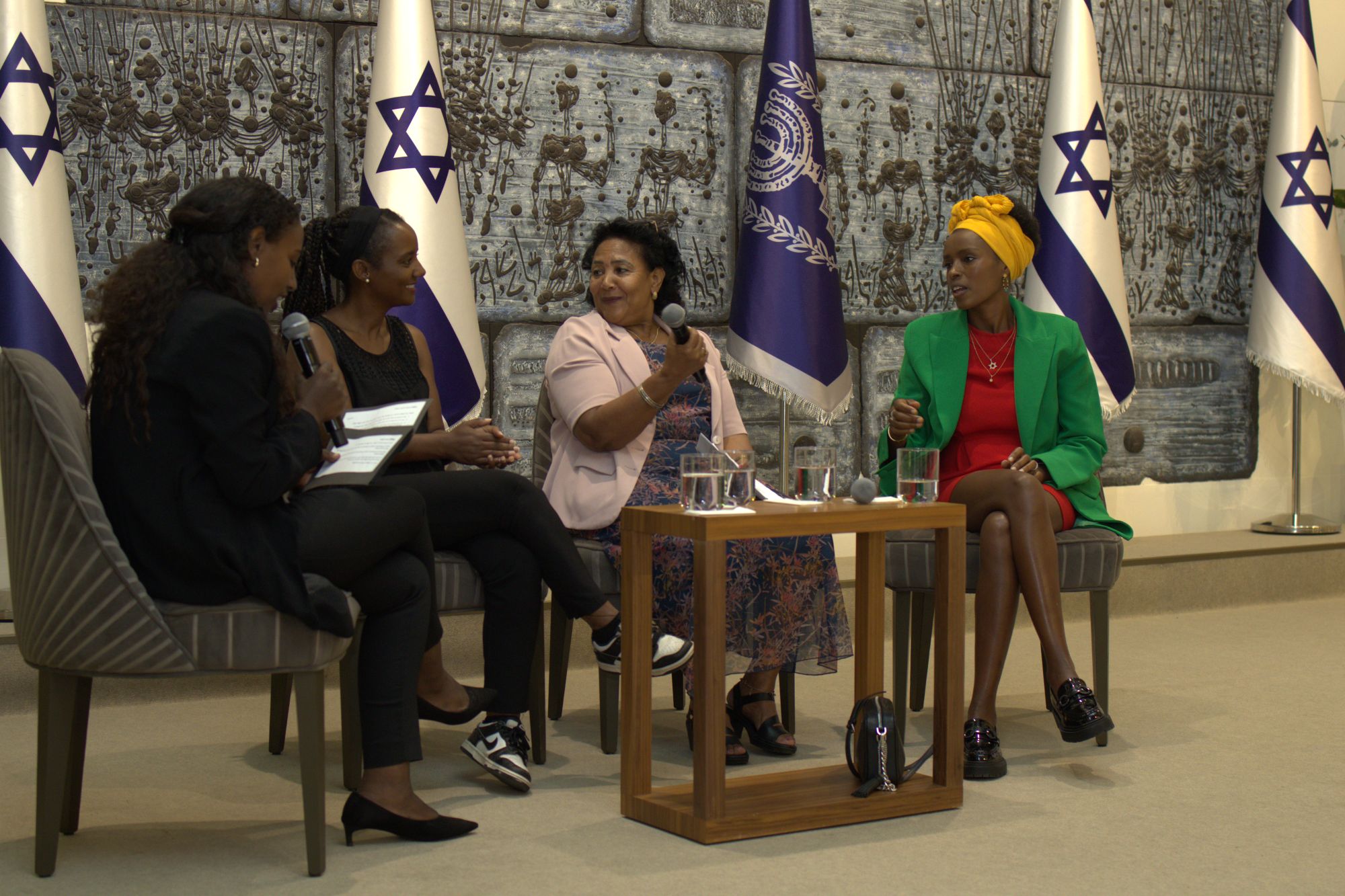
In a book launch event at the Prime Minister’s Residence in Jerusalem in June (see photo at top of page), Empowering Ethiopian Women celebrated the publication of its new book, “Nashim v’Shorashim” (Hebrew for “Women and Roots”). The book, which features pieces written by 48 Ethiopian Israeli women, seeks to “illuminate, strengthen, and empower women through the power of personal stories.” The group plans to distribute the book to Israeli schools and other educational programs, in hopes that it will be “a source of inspiration, empowerment, and self-confidence.” Among the stories is one by Batya Shmueli, who emigrated from Ethiopia with her family in 1991, at age 9. Shmueli, who recently served as a shaliach (Israeli emissary) in South Africa, shares her parents’ history in Ethiopia, her experiences at youth villages and boarding schools, and her successful efforts to overcome expectations and earn university degrees.
Read a translation of Batya Shmueli’s story.
Expanding Rights for Survivors of Child Sexual Abuse
Following years of work by survivors, the Association of Rape Crisis Centers (ARCCI), members of the Knesset, legal experts, and many dedicated partners, the Knesset in July approved landmark legislation significantly extending the statute of limitations for sexual offenses committed against minors and for serious sexual offenses committed against adults. Effective immediately, survivors of sexual abuse within the family can file criminal complaints until the age of 49, while survivors abused outside the family can file until the age of 48. The new law also extends the statute of limitations for serious sexual offenses committed against adults, recognizing that many survivors are unable to come forward immediately.
Trauma, fear, shame, and manipulation mean that many are not able to report the abuse for years, and sometimes decades. Until now, many survivors lost the opportunity to seek justice before they were ready to do so. Extending the statute of limitations will give more survivors the opportunity to report their abuse, seek accountability, and have their voices heard. Writing in The Jerusalem Post, ARCCI’s Executive Director Orit Sulitzeanu explained why this historic achievement matters and why the fight for survivors’ rights is not over.
Learn more about the grant recipients mentioned here at hadassahfoundation.org/grantees. You can view all Hadassah Foundation grantees by grant category or by country.