
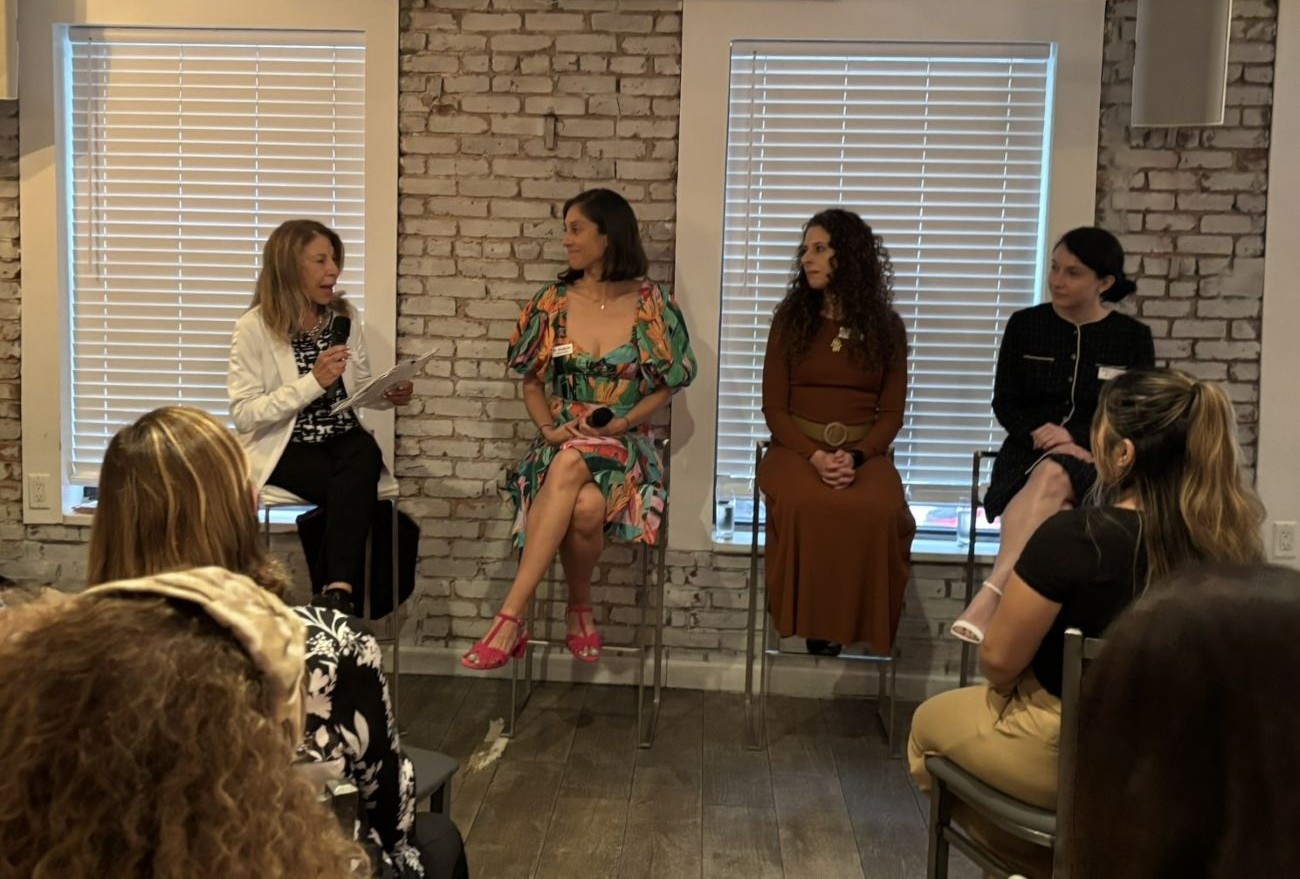
A Hadassah Foundation grant recipient, Jewtina y Co, is the only organization in North America focused on serving the needs of the approximately 400,000 Latin Jews in the region. Earlier this month, Edith Ginsberg (seated at left in above photo), a Hadassah Foundation Board member and chair of the 2026 Core U.S. grant committee, facilitated a panel conversation with Jewtina Founder and CEO Analucia Lopezrevoredo and two Jewtina board members: Deborah Koenigsberger Gutierrez and Melissa Fich. (In above photo, the three are seated left to right.)
The conversation has been condensed and edited. Scroll to the end for full bios of Analucia, Deborah, and Melissa.
Edith: Can you each share a little about your background and how you got involved with Jewtina y Co?
Analucia: I was born in Lima, Peru. When I was two, my family moved to Spain, and by age five, we had settled in Southern California. Growing up in Orange County, between Los Angeles and San Diego, meant being surrounded by two communities that would deeply shape my identity: one of the largest Latino populations in the United States and one of the country’s largest and most diverse Jewish communities. From an early age, I had access to both worlds, but they did not always fit together easily. There were constant questions. People would see my name and say, “Oh my gosh, there are so many letters.” In Jewish spaces especially, my long name often became the first topic of conversation. I remember wanting so badly to make it simpler, shorter, easier for me to blend into the background. My parents ensured that we were able to have access to both elements of who I was, and I had this insight into global Jewry that most of my peers had no idea about, and yet even though it made me feel proud, I lived in those two worlds separately. Often I was met with questions, but I kind of left it at that. A little bit less than 10 years ago, I realized that after so many years of being in a dual role in the Jewish community and in the Latino community, I wanted to find a way to combine these worlds, and in that process I realized that there are almost 400,000 people trying to do the same thing.
Deborah: I was born and raised in Mexico City and moved to the United States when I was 25 with my now husband. Many times when I told people I grew up in Mexico and am Jewish, they would say, “Oh no, but you’re not really Mexican because you’re Jewish.” I would go to Mexican events, or the consulate events, and people would introduce me as “Deborah, she’s from Mexico City, but she’s Jewish.” I found that shocking, and it bothered me, and so six years ago when I, when I read an article on Analucia, I said I need to meet this person.
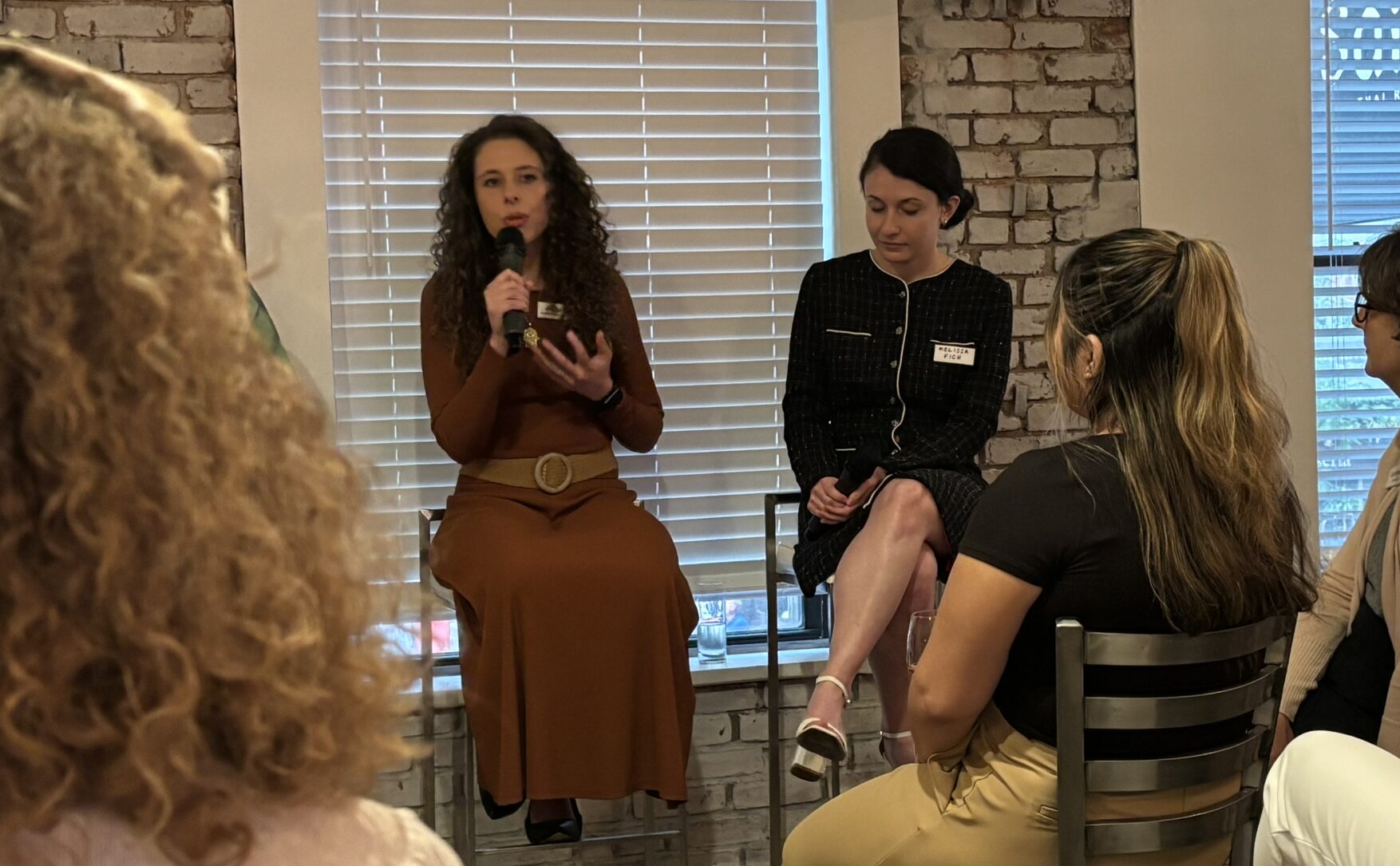
Melissa: I was born and raised here in the United States, but my parents were both immigrants from Venezuela. I grew up speaking Spanish at home, and I had a really strong sense of my Latin identity and my Jewish identity. I didn’t really know other Latin Jews growing up, and I never really felt like I could bring my Latin heritage into Jewish spaces. Then I learned about Jewtina, and specifically the Puentes Fellowship. It’s a really special opportunity for Latin Jews to develop their leadership and their resilience. Being part of this inspiring group and having this space created for us to explore identities was just so powerful, and so I was inspired and honored when I was asked to join the advisory board.
Edith: Tell us about “Voces en Vivo: Not Your Mama’s Jewtinidad,” your program supported by the Hadassah Foundation grant.
Analucia: It’s a storytelling project looking at the different ways in which women and gender non-binary people are breaking through expectations. One of the things that is quite challenging is that we come from very patriarchal societies that have boxed women into certain roles. We just had our pilot group, who were testing their stories two weekends ago in New York. It’s a multi-city project where we are going to be training a number of storytellers. Featured storytellers will go from city to city, and we also engage local storytellers. It was such an incredible opportunity to see people share in a way that fully fills in the blanks with who they are. The number of people who wanted to participate was very high.
Edith: What are some of the unique experiences, challenges, and opportunities Jewish Latina women are facing in this current moment?
Melissa: I’m an immigration attorney, and I work in Brooklyn with immigrants on humanitarian benefit applications. As a Jewish Latina, I speak the same language as many of my clients. I come from a family with an immigration story, and at the same time, Jewish tradition teaches us to welcome the stranger. It’s a very challenging immigration landscape right now, but I also think it’s an opportunity to build bridges to create solidarity. In my work, I’m representing immigrants in court and also connecting them to social services, including some of my female clients who I connect with reproductive access services. It’s a really unique time to bridge my Jewish and Latin heritage.
Deborah: What gives me hope as a Latin Jewish woman is that I don’t experience these identities in isolation. I carry the joys and the struggles of both my Latino and Jewish communities, and that gives me a unique perspective on what it means to build empathy, solidarity, and belonging.
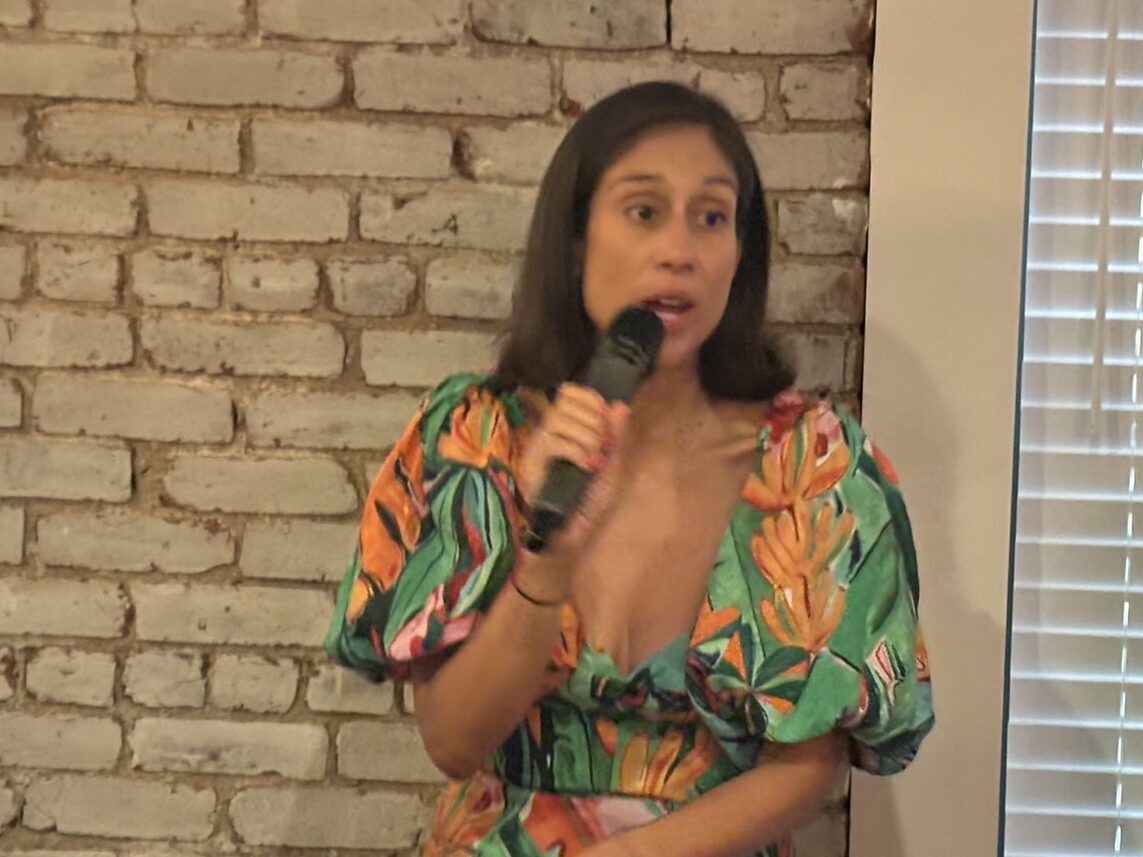 Analucia: We are very much at this bridge of knowing all of these things that are impacting the Latino community, and of course, especially in a post-October 7 world, we also have access to the pain and the suffering of the Jewish community. We are really committed to being present in both these worlds. We are navigating a wide range of identities in moments that have been trying to tear us apart.
Edith: Does being Jewish and Latina help you talk about antisemitism with your Latino colleagues who are not Jewish?
Analucia: There’s no question that, since October 7, we’ve seen a significant rise in antisemitism. But we’ve also learned that if we want to build meaningful relationships with other communities—particularly within the Latino community—we have to begin by understanding what they’re carrying, too. Every community has its own urgent realities. Over the past few years, immigration has been one of the defining issues for many Latino communities, and increasingly for many Jewish families as well.
We don’t show up saying, “We’re here to talk to you about antisemitism.” We show up saying, “Tell us what matters most to you right now. What challenges are you facing? How can we be in relationship with one another?” That’s where trust begins. Because genuine bridge-building can’t be driven by only one community’s priorities. If we only show up with our own agenda, we’re not building a relationship—we’re asking for one-sided support. Lasting relationships are built when every community feels seen, heard, and invested in one another’s well-being.
Speaker Bios
Dr. Analucía Lopezrevoredo (Jewtina Founder & CEO)
Analucia is a sociologist, organizational leader, and bridgebuilder whose work sits at the intersection of human migration, transnational identity, and global Jewish life
In 2019, Analucía founded Jewtina y Co., cultivating a global community where Latin Jews can explore and celebrate the rich mosaic of Latin-Jewish peoplehood. Prior to Jewtina y Co., she played a pivotal role at organizations like JIMENA, OneTable, and Bend the Arc, where she pioneered frameworks that deepened the understanding of multicultural Jewish identity.
Analucía is a 2004 National Young Woman of Distinction award recipient and Fulbright alumna. She sits on the board of American Jewish World Service (AJWS), where she contributes to global Jewish and human rights initiatives. Analucía is also an active member of the Schusterman Foundation’s ROI Community and an alumna of several prestigious leadership programs, including Elluminate’s Collective, the Wexner Foundation’s Field Fellowship, and the Selah Leadership Program.
Born in Lima, Peru, Analucía has traveled to over 155 countries across all seven continents and speaks five languages, embodying a lifelong commitment to global citizenry. She is a sought-after facilitator and speaker who has led programs in countries including Cambodia, Colombia, Cuba, El Salvador, Greece, India, Mexico, Mongolia, Panama, Peru, Russia, Thailand, and Trinidad and Tobago. Across these diverse contexts, she brings an intersectional lens and a deep dedication to cultural bridge-building, helping communities engage with identity, belonging, and collective resilience on a global scale.
Deborah Koenigsberger Gutierrez (Jewtina board)
Deborah is a community leader, tech executive, and entrepreneur who brings her international background and passion for combining diverse identities to make positive impacts in both professional and community spaces. As president of Tribeca Synagogue and chief of staff at Trips Platform, Inc., she bridges cultural innovation with strategic leadership. Deborah’s commitment to celebrating Jewish-Latino heritage led her to join Jewtina y Co.’s board and to found The Mexican Judaica Store, where she creates unique pieces that honor both traditions.
Melissa Fich (Jewtina board)
Melissa is a staff attorney at The Door’s Legal Services Center, where she represents undocumented youth in their immigration court proceedings. Previously, she was a litigation fellow at the International Refugee Assistance Project (IRAP), working on impact litigation to advance and defend the rights of refugees, asylum seekers, and other people in need of humanitarian relocation. As the daughter of Venezuelan Jewish immigrants, Melissa is passionate about her work and serving on Jewtina’s board to honor her multicultural Jewish heritage. She holds a J.D. from Yale Law School, where she was on the executive boards of the Jewish and Latinx law students’ associations, and a B.A. from Columbia University.